


 844-937-8679


 844-937-8679
Magazine
91制片厂 Scholar
Journal for research & scholarship
About the Scholar
91制片厂 Scholar showcases the commitment of 91制片厂 faculty, students and alumni to help foster the process of leading research through evidence-based practice. It serves as a dynamic and robust platform for sharing research results and outcomes and exploring their relationship to the broader scope of learning and scholarship.
91制片厂 Scholar is a fully open access journal. All articles are freely available to read, download, and share immediately upon publication. Authors retain copyright of their work. Articles are published under a Creative Commons Attribution 4.0 International (CC BY 4.0) license, which permits unrestricted use, distribution, and reproduction in any medium, provided the original author and source are properly credited.
Moving from Periodical to Journal Status
The 91制片厂 Scholar has evolved several times since its inception as a fledgling periodical聽back in 2017. From that time, the aspirations for a potential聽聽journal took hold. Each year provided an opportunity to take the transformative author-works to new levels. Strategically, we have now accomplished what we first set out to do from our auspicious beginnings and have achieved this through a series of intentional milestones over the years. We are proud to announce that we have established the now current status of the 91制片厂 Scholar as an official peer-reviewed journal that will not only serve as a platform for scholarship, but also capture the transformative work of scholars in a formally recognized academic journal with the capacity for an ever-growing global reach.聽
Our Journey
February 4, 2022 - Foundational Recognition: Library of Congress (ISSN Assignment)
The journal had received its first stamp of approval through an assigned official International Standard Serial Number (ISSN) from the U.S. ISSN Center at the Library of Congress. This first achievement formally established聽The 91制片厂 Scholar as a recognized serial publication within the global scholarly record.
August 14, 2025 - Scholarly Infrastructure: Crossref Membership and DOI Implementation
A few years later, through Crossref, The 91制片厂 Scholar聽was formally provided access to begin assigning Digital Object Identifiers (DOIs) to published articles in the journal, thus ensuring persistent access, reliable citation, and integration within the global research ecosystem while also providing greater credibility for our authors.
March 12, 2026 - Global Indexing: Directory of Open Access Journals (DOAJ)
Final acceptance was recently achieved through our accepted application into the Directory of Open Access Journals (DOAJ) which now confirms The 91制片厂 Scholar鈥檚 alignment with international standards for quality, transparency, and open access publishing, while significantly expanding its visibility and credibility worldwide.
This milestone of achievements belongs to our community; congratulations to all who have contributed to the growth of The 91制片厂 Scholar Journal!
Summer/Fall Issue Coming Soon!

Summer/fall 2026
Developing Dynamic Workforce Talent from Within聽
Coming soon: Volume 9, Issue 1 of 91制片厂 Scholar explores the evolving relationship between people, technology, and the changing world of work. This edition brings together timely perspectives on artificial intelligence, professional practice, leadership, learning, and the human dimensions of technological change. Look for the new Summer/Fall 2026 issue in the weeks ahead.
91制片厂 Scholar Call for Winter/Fall Edition 2026 - Now Open
Vol. 9, Issue 2-AI as the Operating Condition:聽How Intelligent Systems Are Reshaping the Way We Lead, Work, and Learn
Described fields below are open for this issue from technology, business and leadership,education, organizational wellness, healthcare, sociology, and psychology. We encourage the following article [type] submissions:
- Original Research (Research Article/Original Paper)
- Review Articles (Narrative, Systematic, or Meta-analysis) - Synthesis of existing literature
- Short Reports (Early stage research findings)
- Methods, Data, and Design-Focused Papers (Research Methods, Tools or Analytical Approaches)
- Conceptual (Theory-backed view points, perspectives, field trends)
- Clinical/Applied (Case Study/Case Reports)
The 91制片厂 Scholar accepts submissions for article content within and external to the university. For further details on submission criteria, see the requirements below, or you may contact the Editor, Dr. Juana Lang at聽vickyhavana@email.phoenix.edu聽or the Managing Editor Dr. Mark McCaslin at聽mlmccasl@email.phoenix.edu
Find out more about the Fall/Winter 2026 Issue
Started in 2017, the 91制片厂 Scholar began as a periodical created to showcase research conducted within the 91制片厂, College of Doctoral Studies. Since then, the 91制片厂 Scholar has developed into a robust research periodical with its own ISSN from the National Library of Congress. The primary areas for research the periodical seeks are contained within the following disciplines:
- Education
- Technology
- Engagement and Belonging
- Healthcare
- Psychology
- Business
- Leadership
- Organizational Studies
Additionally, the focus remains on scholarship and practice within research where authors can share their current research, article reviews, conceptual papers, and empirical research, thereby extending to the academic community at large and on a much broader scale to all communities with issues that affect society and the world.
The benefits of engaging the journal include:
- Access to current topical issues within the social sciences.
- Gaining a greater understanding of a variety of social science issues.
- Helping support the readers' own research interests as reference material.
- Helping guide those seeking to understand a specific topic or issue.
For researchers submitting, the periodical is a conduit for sharing and expanding their findings, exploring the potential of connecting with a broader audience, enhancing their own writing and authoring credentials, and contributing to the body of research on specialized topical matter.
Publication Frequency
The 91制片厂 Scholar publishes two scheduled issues during the Spring and Fall quarters, plus one or more special issues annually. The special issue themes and deadlines are generally published at least six months before the publication date.
Open Access Policy
The 91制片厂 Scholar is an open-access journal, meaning that all content is freely available to the user or his/her institution without charge. Users are allowed to read, download, copy, distribute, print, search, or link to the full texts of the articles or use them for any other lawful purpose without asking the publisher's or the author's prior permission. This is in accordance with the BOAI definition of open access. There is also no charge for researchers seeking to publish within the periodical.
Open Archive All past issues of the 91制片厂 Scholar are available for review at 91制片厂 Scholar Archive.
Sponsors
Center for Leadership Studies & Organizational Research
The Center for Leadership Studies and Organizational Research (CLSOR) regards the spectrum of business and organization as all-encompassing, where the potentials of scholar-practitioner engagement intersect with industry dynamics to uncover the possibilities that emerge when research is applied. Our focus is on the core competence of UOPX regarding leadership and organizational practice. These aspects covers a wide range of disciplnes from all aspects of industry including healthcare, technology, psychology, and so much more, where business is at the intersectional fulcrum. In a world where business practices and leadership have become an even greater imperative, we seek to engage research that always reflects some of the most innovative and relevant topical matters.
Center for Organizational Wellness, Engagement and Belonging
CO-WEB serves as the research home for faculty, students and alumni who have an expressed interest or have an existing research agenda related to organizational functioning in workplaces and communities of practice. At our center, we generate interdisciplinary research and scholarship that examines factors that contribute to organizational and workplace wellness, and stakeholder engagement and belonging. We conduct rigorous studies, synthesize the latest findings for scholarship, and collaborate with thought leaders to provide actionable recommendations and guidance for organizations in all communities of practice. Our work not only explores the individual and organizational benefits of wellness, engagement, and belonging but also provides a roadmap for organizations to unlock the full potential of their workforce.
Center for Educational and Instructional Technology Research
The CEITR is the go-to department for faculty, staff, students, and alumni who are passionate about using technology-based tools, learning theories, and instructional strategies to promote quality teaching and learning. With a strong focus on K-12, higher education, and corporate settings in both online and face-to-face formats, the center proactively tackles the challenges related to online teaching and learning, as well as global trends and issues in education.聽 The center is a place where students, alumni, and faculty will find the collegiality and socialization necessary for an advanced community of learning. The research will be cultivated and supported in a variety of ways including offering the center membership, research fellowship, or student assistantship.
The Career Institute
91制片厂 Career Institute庐 was created to address broad, persistent and systemic barriers to career advancement through research-based solutions and impactful partnerships that break down barriers Americans face in their careers.
The following are active and current members of the editorial board for the 91制片厂 Scholar.
Executive Editor
Hinrich Eylers, Ph.D., Vice Provost for the 91制片厂 College of Doctoral Studies
Editor-in-Chief
Mark McCaslin, Ph.D., Associate Chair for the Center for Leadership Studies and Organizational Research
Editor
Juana Lang, Ed.D., General Studies Faculty
Editor and Designer
Challie Facemire Ph.D.
91制片厂 Scholar Director and Lead Designer
Rodney Luster, Ph.D., LPC, Senior Director of Research Strategy, Innovation, and Development, Center for Leadership Studies and Organizational Research
Associate Editors
Kimberly Underwood, Ph.D. Chair for the Center for Organizational Wellness, Engagement and Belonging
Mansureh Kebritchi, Ph.D., Chair for the Center for Educational and Instructional Technology Research
Editorial Board
Stella Smith, Ph.D.-Associate Research Chair for the Center for Educational and Instructional Technology Research
Louise Underdahl, Ph.D.-Fellow for the Center for Educational and Instructional Technology Research
Sandra Sessoms-Penny, Ed.D.-Fellow for the聽Center for Organizational Wellness, Engagement and Belonging
Joy Taylor, Ed.D.-Fellow for the Center for聽Center for Organizational Wellness, Engagement and Belonging
Reviewers
Dr. Lucinda Hines
Dr. Louise Underdahl
Dr. Kayla Tennin
Dr.聽 Kim Sanders
Dr. Pamela Darbyshire
Dr. Stephen Notaro
Dr.Tamika Fuller
Dr. Michelle Reeves
Dr. Donald Munday
Dr. Karolina Achirri
Dr. Tina Miller
Dr. Lisa Thompson
Dr. Wellington Williams Jr.
Editorial Workflow and Peer Review Policy
Effective [6.10.2026] 路 Version 1.0
This policy describes how manuscripts are handled from submission to final decision. It is designed to ensure fair, timely, and consistent evaluation while respecting the time and goodwill of our volunteer reviewers and editorial team.
1. Scope and Principles
The journal relies on a volunteer editorial team and volunteer peer reviewers. The procedures below balance two commitments: maintaining the scholarly quality of published work, and ensuring that the demands placed on reviewers remain reasonable and sustainable.
Three principles guide the workflow:
- Quality. Every manuscript receives rigorous, expert evaluation before a decision is made.
- Sustainability. No reviewer is expected to perform more than one comprehensive review of the same manuscript.
- Timeliness. Manuscripts move through defined stages with clear limits on the number of revision cycles.
2. Submission and Initial Editorial Screening
Upon submission, the handling editor screens the manuscript for fit with the journal鈥檚 scope, adherence to formatting and ethical requirements, and overall readiness for review. Manuscripts that fall outside scope or fail to meet basic standards may be declined or returned to the author without external review (a 鈥渄esk decision鈥�).
Manuscripts that pass initial screening are assigned to peer reviewers.
3. Peer Review
3.1 Comprehensive Review
Each manuscript is evaluated by qualified reviewers who provide a single comprehensive review. A comprehensive review entails a full, detailed assessment of the manuscript鈥檚 contribution, methods, evidence, and presentation, together with specific recommendations to the editor.
Reviewers are asked to undertake one comprehensive review per manuscript. They are not expected, as a matter of routine, to conduct repeated comprehensive reviews of successive versions of the same manuscript.
3.2 Reviewer Recommendations
On completing a review, reviewers recommend one of the following to the editor: accept, minor revision, major revision (revise and resubmit), or reject. The editorial team weighs reviewer recommendations alongside its own assessment in reaching a decision.
4. Revision and Resubmission
4.1 Limit on Revision Cycles
Manuscripts receiving a revise-and-resubmit decision will ordinarily be permitted up to two rounds of revision. If substantial concerns identified by reviewers remain unresolved after the second revision, the editorial team may reject the manuscript.
4.2 Reviewer Involvement in Revisions
To avoid overburdening volunteer reviewers, the evaluation of revised manuscripts is, by default, the responsibility of the editorial team rather than the original reviewers. Specifically:
- After a reviewer has completed one comprehensive review, the handling editor assesses the author鈥檚 revisions and response to reviewer comments.
- Original reviewers may be invited to comment on a revision only at the editor鈥檚 discretion, and such requests should be limited and clearly scoped (for example, confirming whether a specific concern has been addressed) rather than constituting a further comprehensive review.
- Where reviewer concerns from the first review remain unresolved, the editorial team makes the final recommendation 鈥� including rejection 鈥� without requiring an additional full review from volunteers.
5. Editorial Decisions
Final decisions rest with the editorial team. Decisions are based on the comprehensive review(s), the author鈥檚 responses and revisions, and the editorial team鈥檚 independent judgment. Possible outcomes at any stage include accept, minor revision, major revision (within the two-round limit), and reject.
Where a decision differs from a reviewer鈥檚 recommendation, the editorial team provides the author with a clear rationale.
6. Protecting Reviewer Effort
This policy formalizes the journal鈥檚 commitment to its volunteer reviewers. By capping comprehensive reviews at one per manuscript, shifting the assessment of revisions to editorial staff, and limiting authors to two revision cycles, the journal ensures that reviewer goodwill is not exhausted by open-ended or repetitive review demands.
7. Review and Amendment
This policy will be reviewed periodically by the editorial team and may be amended to reflect the journal鈥檚 evolving needs. The current version supersedes all prior practice.
Mark L. McCaslin, Ph.D.
Editor-in-Chief 鈥� The 91制片厂 Scholar
University Research Methodologist - Doctoral Instructor
Center for聽Leadership聽and Entrepreneurial Associate Research Chair
91制片厂
Senior Editor 鈥� The Qualitative Report
Editorial Board 鈥� Journal for Leadership Studies
The 91制片厂 Scholar allows for the submission of research articles, thought pieces, and original research. Publishing in the 91制片厂 Scholar is voluntary, and we offer no compensation or guarantee of acceptance to prospective authors. Please review our process below if you plan to submit.
Submitting research work to the 91制片厂 Scholar periodical involves a series of steps designed to ensure that the submission is thorough, adheres to the 91制片厂 Scholar guidelines, and has the highest chance of acceptance. Here is the current process for research authors:
Step 1: Selecting the Appropriate Journal [Theme]
1.1 Review a Periodical Issue [Scope and Aims]
- Read through a 91制片厂 Scholar: It is important to look through an edition of the 91制片厂 Scholar to get an idea of the kind of articles that go into each issue.
- Identify the theme of the issue: Ensure you read each call for proposed work and the theme of the "call" to ensure your article submission aligns with the scope and aims of the periodical.
- Evaluate the audience: Consider the 91制片厂 Scholar's target audience [Researchers, Students, Faculty, Alumni, General Public] and whether your research or writing target (content) will be of interest to them.
1.2 The 91制片厂 Scholar Guidelines
- Read submission "call for article" guidelines: Thoroughly read the submission guidelines provided by the 91制片厂 Scholar, which typically include formatting, word count, and any APA style guidelines.
- Faculty Journal Submission Agreement (JSA): Should we accept your work you will be provided a JSA to fill out and return to us. The agreement allows us to utilize your work in the scope of the 91制片厂 Scholar but does not preclude you from using it elsewhere. You can read the sample JSA here. Sample JSA [not for submission unless received through Docusign].
Step 2: Preparing the Manuscript
2.1 Manuscript Structure and Formatting- Please review the tab for author guidelines.
- Adhere to guidelines: Follow 91制片厂 Scholar's formatting instructions regarding font type, size, margins, and headings. We will turn it back to authors who do not follow these prescriptives.
- Consistent style: Ensure consistency in writing style, terminology, and units of measurement.
- Language: If necessary, seek professional language editing services to ensure clarity and grammatical accuracy. We ask that you proof, proof, and proof your work to minimize the time it takes to get your work ready for publishing.
Step 3: Supplementary Materials
3.1 Figures and Tables
- Quality and clarity: Ensure that all figures and tables are high-quality, clear, and correctly labeled. We will turn down blurry imaging.
- Separate files: Prepare figures and tables in separate files if required by the journal.
- Legends and captions: Provide detailed legends and captions for all figures and tables.
- Ensure that the work is your own construct: Your tables and graphs should be your work, and if you are using someone else's tables/charts, you must have express permission to do so before submitting.
3.2 Additional Files
- Supplementary information: Include supplementary data or additional materials that support the main manuscript.
- Compliance with guidelines: Ensure all supplementary files comply with the 91制片厂 Scholar's requirements for format and file type.
Step 4: Ethical Considerations
4.1 Author Contributions
- Authorship criteria: Ensure all listed authors meet the criteria for authorship and agree to the submission.
4.2 Plagiarism Policy
- Plagiarism will not be tolerated.
- Plagiarism: The intentional or unintentional use of work that is not one鈥檚 own, in whole or in part, without acknowledging the source and presenting that material as one鈥檚 own original academic work. This includes, but is not limited to:
- Reproduction and submission of work which is not one鈥檚 own, whether published or unpublished. This includes using materials from third parties that sell or provide academic papers or assignments, regardless of how the third party describes their mission, purpose, or materials. This also includes output generated by artificial intelligence tools.
- Using another鈥檚 ideas, written words, or intellectual property without properly acknowledging the source:
- 聽Quoting a source word-for-word without providing quotation marks and citations.
- 聽Submitting work that is substantially identical to another source in content or organization without appropriately citing the source.
- Using other intellectual property in a work without appropriate citations, permissions, or rights (when applicable). Intellectual
- property includes but is not limited to images, presentations, videos, software programs, computer code, charts, figures, illustrations, and artistic or musical composition.
- Authors must disclose any use of generative AI in manuscript preparation. AI may assist with editing or clarity but cannot be the authoring agent of your submitted work. Human authors retain full responsibility for the accuracy, originality, and integrity of all content associated with their work.
Step 5: Submitting the Manuscript
5.1 Submission Portal
- Typical "Calls for Articles" will be posted on the website: Each 91制片厂 Scholar may have a different Editor. Thus, we encourage you to look at the featured theme each time to ensure the correct editor of the issue you want to submit for is listed. You may also reach out to rodney.luster@phoenix.edu for more information.
- Follow instructions: Carefully follow the instructions for submitting your manuscript and supplementary materials. Most times we will use Dropbox as a receptacle for receiving works.
- Metadata entry: Enter all required metadata, including author information, keywords, and abstract during the call for articles.
5.2 File Upload
- Manuscript file: Upload the main manuscript file in the required format (e.g., Word).
- Supplementary files: Upload all supplementary files, including figures, tables, and additional data.
5.3 Confirmation
- Submission confirmation: Ensure that you receive a submission confirmation from the Editor.
Step 6: Post-Submission
6.1 Review Process
- Initial editorial check: The 91制片厂 Scholar staff will perform an initial check to ensure the manuscript fits the scope and meets basic requirements.
- Administrative review: The manuscript will be sent to the designated Editor and staff for evaluation of its quality, originality, and significance.
- Revisions: Be prepared to receive feedback and revise your manuscript based on reviewer comments.
6.2 Decision and Response
- Editorial decision: The editor will make a decision based on peer reviews, which could be acceptance, minor revisions, major revisions, or rejection.
- Revisions and resubmission: If revisions are requested, carefully address all comments and resubmit the revised manuscript within the specified timeframe.
- Acceptance: Once accepted, follow any additional instructions for final submission, including copyright transfer and proof corrections.
6.3 Post-Acceptance
- Proofreading: Review the proofs of your manuscript carefully for any errors or required corrections.
- Publication: Your article will be published in an upcoming issue of the 91制片厂 Scholar depending on our needs, both online and in print (if applicable).
- Faculty Journal Submission Agreement
- For potential authors, you should submit your proposed article to the Editor/or link for contact information when provided. Articles will go through the review process and if accepted, potential authors will be sent a Docusign document to sign for release.聽
- Promotion: Consider promoting your published work through academic networks, social media, and conferences.
Editorial Tools and Transparency
The 91制片厂 Scholar editorial team is committed to a clear and consistent review process. As part of our editorial quality checks, submissions may be run through Recite (reciteworks.com), an automated citation and reference checking tool. Recite compares in-text citations against the reference list and flags possible inconsistencies, including author or date mismatches, missing or unused references, and APA style issues, and it cross-checks references against databases such as Crossref to surface retracted works. Recite does not assess the quality, originality, or content of your scholarship, and it does not generate or rewrite text. We treat its reports as first line insights for our editors and authors, not as final decision outcomes. However, we will verify and ask authors to revise any items as needed for our publishing process.聽
Conclusion
Submitting a piece of work to a periodical or journal like the 91制片厂 Scholar requires meticulous preparation, adherence to guidelines, and responsiveness to feedback. By following this detailed process, authors can enhance the likelihood of their work being accepted and published, contributing valuable knowledge to their field.

| Volume / Issue | Target Publication | Submission & Selection | Peer Review | Author Revisions | Copyediting / Production |
|---|---|---|---|---|---|
| Vol. 9, Issue 1 | Aug./Sept. 2026 | Complete | Complete | Complete | In progress |
| Vol. 9, Issue 2 | December 2026 | 础耻驳.鈥揝别辫迟. | 厂别辫迟.鈥揙肠迟. | Oct. | 狈辞惫.鈥揇别肠. |
| Vol. 10, Issue 1 | June 2027 | 闯补苍.鈥揊别产. | 贵别产.鈥揗补谤. | 惭补谤.鈥揂辫谤. | 惭补测鈥揓耻苍别 |
| Vol. 10, Issue 2 | December 2027 | 闯耻濒测鈥揂耻驳. | 础耻驳.鈥揝别辫迟. | 厂别辫迟.鈥揙肠迟. | 狈辞惫.鈥揇别肠. |
| Vol. 11, Issue 1 | June 2028 | 闯补苍.鈥揊别产. | 贵别产.鈥揗补谤. | 惭补谤.鈥揂辫谤. | 惭补测鈥揓耻苍别 |
| Vol. 11, Issue 2 | December 2028 | 闯耻濒测鈥揂耻驳. | 础耻驳.鈥揝别辫迟. | 厂别辫迟.鈥揙肠迟. | 狈辞惫.鈥揇别肠. |
The following is our Peer Reviewer rubric which is used to review all articles submitted for the 91制片厂 Scholar. For Peer Reviewers, you may download it here.
91制片厂 Scholar is a fully open access journal. All content is freely available to readers immediately upon publication without subscription or payment. Readers are permitted to read, download, copy, distribute, print, search, or link to the full texts of articles without asking prior permission聽provided the original author and source are properly credited.
Authors retain copyright of their work published in 91制片厂 Scholar. All articles are published under the Creative Commons Attribution 4.0 International License (CC BY 4.0). This license allows others to share and adapt the work for any purpose, provided appropriate credit is given to the original author and source. License details:
91制片厂 Scholar is an open access journal and currently publishes all articles under the Creative Commons Attribution 4.0 International License (CC BY 4.0).
Some earlier issues were produced using a previous publication template that included the phrase 鈥淎ll Rights Reserved.鈥� This wording reflects a legacy formatting practice and does not represent the journal鈥檚 current licensing policy. The journal is committed to open access publishing under the CC BY 4.0 license, and the legacy wording will be systematically removed from templates and future publications.
Past issues [2025-2023]

FALL 2025
Volume 8, Issue 2
This issue explores the importance of identifying and developing internal talent. Research highlights a gap between the career opportunities employers provide and employees鈥� awareness of them. While many organizations offer pathways for advancement and skill development, employees may not always recognize how to access them. This disconnect underscores the importance of clearer communication, meaningful dialogue, and more visible opportunities for internal mobility and professional development.

spring 2025
Volume 8, Issue 1
This special anthology edition of the 91制片厂 Scholar celebrates the 2024 Knowledge Without Boundaries (KWB) annual research summit. As a reflection of this transformative three-day research summit, this edition celebrates a period marked by curiosity, collaboration, and a collective commitment to pushing the boundaries of knowledge.

Fall 2024
Volume 7, Issue 2
In an era of significant global challenges, the call for transformative research and practice has never been more urgent. The Fall 2024 edition of 91制片厂 Scholar delves into the advancements reshaping our understanding of the world and fostering innovative solutions.
sPRING/SUMMER 2024
Volume 7, Issue 1
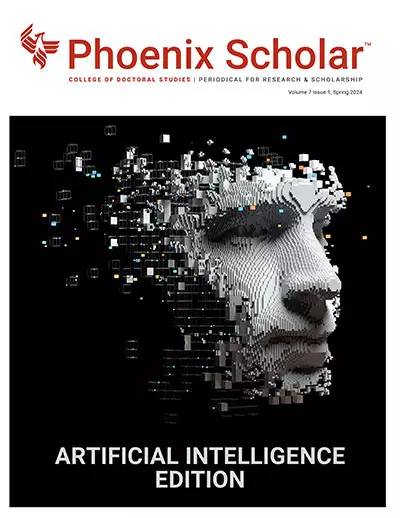
This issue offers a number of perspectives on AI's potential to enhance teaching methodologies, streamline classroom processes, and the possibility to catalyze groundbreaking research endeavors.

Winter 2023/2024
Volume 6, Issue 3
In this Special Proceedings Edition, we鈥檝e assembled the peer-reviewed presentation abstracts from the 2023 KWB Summit, including the 2023 College of Doctoral Studies "Dissertation of the Year" winners and a special interview with the KWB Keynote Speaker Dr. Cheryl Lentz.

Summer 2023
Volume 6, Issue 2
In this issue, we look at how the role of education in shaping future leaders and thinkers has gained even more prominence and how, where, and when to assess is an important part of the metrics and dialog.

Spring 2023
Volume 6, Issue 1
In this special edition of the 91制片厂 Scholar, we focus on exploring adult learners鈥� teaching and learning challenges and approaches.
Archived editions
Creative Commons Licensing and Copyright
Directory of Open Access Journals

91制片厂 Scholar is indexed in the Directory of Open Access Journals.
Note for faculty in California聽
This is a non-compensable activity. Participation in College of Doctoral Studies calls for proposals and activities are not job related, there is no benefit or detriment to participation, no unwritten expectation that you participate, and no critical work information will be conveyed.
The 91制片厂 Scholar鈩� is published biannually May and November by the Research and Scholarship Enterprise (RSE) in conjunction with the College of Doctoral Studies (CDS). All articles published in 91制片厂 Scholar are distributed under the Creative Commons Attribution 4.0 International License (CC BY 4.0).